
For a long time, economic crises were described as collective experiences. Recessions broadly affected workers, companies, and consumers; recoveries, when they came, were also narrated as shared processes. In recent years, however, this narrative has fragmented. In its place emerged a simple and powerful metaphor — the “K-shaped” economy — to explain a scenario in which growth and hardship not only coexist but follow opposite trajectories.
The term, which entered the popular economic vocabulary during the Covid-19 pandemic, was meant to describe a specific moment: while part of the population recovered quickly, another continued to decline. The upward line of the “K” represented those who prospered; the downward line, those who were left behind. What few imagined is that this image would cease to be temporary and would become a persistent feature of the American economy.
Five years after the start of the pandemic, the “K” not only remains, it has expanded.
Growth that does not reach everyone
The numbers, taken in isolation, seem optimistic. According to the National Retail Federation (NRF), spending during the holiday season could surpass US$1 trillion for the first time in history. Consumption remains resilient, the financial market reaches historic highs, and luxury companies report robust results.
But behind these aggregate data lies a more unequal reality. Much of this growth is driven by a relatively small segment of the population. Recent estimates from Moody’s Analytics indicate that the wealthiest 10% of American households were responsible for nearly half of all consumption in the country. In other words, the engine of the economy is concentrated at the top.
For many low- and middle-income Americans, the scenario is quite different. They continue to buy, but in another way. They opt for cheaper versions of the same products, turn to discount stores, or finance basic expenses with credit cards. The economy keeps moving, but not evenly.
This divergence is especially visible in seasonal consumption. The same period that marks international travel, expensive dinners, and high-value gifts for some represents restraint, debt, and difficult choices for others. It is the K-shaped economy, in its holiday version.
From temporary concept to permanent diagnosis
The expression gained strength in 2020, when different social groups experienced the post-pandemic recovery in radically different ways. Workers who were able to migrate to remote work, especially in technology and finance, saw their incomes and wealth grow. Others, in in-person and low-paid jobs, faced unemployment, instability, and health risks.
Peter Atwater, a professor of economics at the College of William & Mary, is often cited as the one responsible for popularizing the term. He recalls seeing the expression used on social media to describe uneven recoveries and thinking the metaphor was fitting. At the time, he imagined it would be temporary. It was not.
Since then, financial markets have entered a prolonged cycle of appreciation, benefiting those who already owned assets. The wealth of the richest grew at an accelerated pace, driven by stocks, real estate, and investments. For these families, the economy worked like an escalator.
For others, especially those with lower incomes, the experience was marked by continuous pressure. Although wages rose nominally, growth was slower among lower-income workers. Data from the Federal Reserve Bank of Atlanta show that wage gains in this group have been losing momentum, while essential costs such as housing, food, transportation, and healthcare remain high.
Inflation, interest rates, and the weight of daily life
Inflation, which began as a temporary phenomenon after the pandemic, left lasting marks on household budgets. Even with its recent slowdown, prices remain significantly higher than they were five years ago. For those living on the edge, this difference is not abstract; it appears in the grocery cart, in rent, and in monthly bills.
The increase in interest rates, promoted by the Federal Reserve to contain inflation, added another layer of inequality. Families with financial assets were able to benefit from higher returns on investments. Those who depend on credit felt the opposite impact: more expensive loans, revolving debt that is harder to pay off, and less room to absorb unexpected shocks.
Credit cards have become a survival tool for many. But they have also increased financial vulnerability. The result is consumption that continues to exist, but is sustained by growing indebtedness.
The picture in sentiment surveys
Surveys help translate these contrasts into numbers. In the Bank of America 2025 Year-End Survey, 62% of respondents reported feeling financial difficulties. Among them, 87% said they planned to shop at discount stores.
This misalignment between positive macroeconomic data and families’ everyday perceptions appears consistently in consumer sentiment surveys. Joanne Hsu, director of Consumer Surveys at the University of Michigan, observes that economic bifurcation is clearly visible in these indicators. While higher-income consumers show confidence, lower-income consumers report anxiety, uncertainty, and frustration.
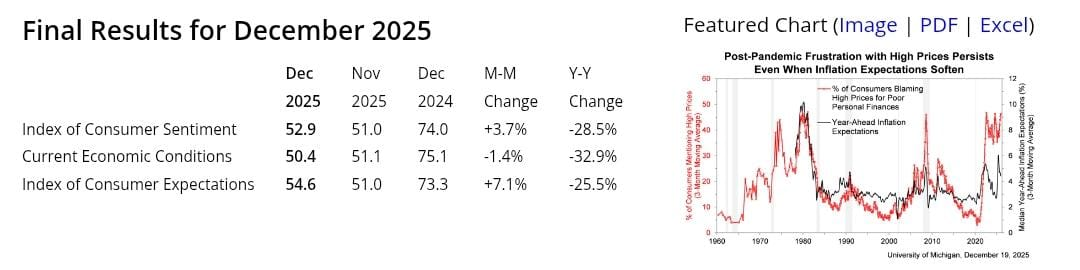
These are not just numbers, but life experiences that increasingly diverge.
Companies, profits, and the logic of the “K”
The K-shaped economy also shows up in corporate balance sheets. In earnings calls with investors, executives often describe two distinct behaviors: consumers who seek lower prices and cut spending, and others who continue buying premium products without hesitation.
Companies focused on high-income consumers, such as luxury brands and airlines with premium offerings, have benefited from this dynamic. Delta Air Lines, for example, recently stated that sales of premium tickets were outperforming those of economy class, a clear sign that luxury consumption remains resilient.
At the same time, retailers focused on price-sensitive consumers report pressured margins, higher customer turnover, and constant demand for promotions. The market is not shrinking; it is splitting.
Official recognition of inequality
The leadership of the Federal Reserve itself has publicly acknowledged this disparity. Jerome H. Powell, the institution’s chair, stated in a recent press conference that many companies have been reporting a bifurcated economy, in which lower-income consumers buy less and shift to cheaper options, while wealthier consumers continue to spend.
This admission is significant. It suggests that inequality is not merely a social perception or a political debate, but a structural factor that influences economic decisions, monetary policy, and growth projections.
Two worlds, one country
For Atwater, the central problem is not only income disparity, but the growing distance between lived experiences. Americans, according to him, have come to inhabit two distinct worlds within the same country. Those at the base of the social pyramid cannot ignore the visible abundance above them, whether on social media, in storefronts, or in data announcing record consumption.
This coexistence of prosperity and hardship creates deep tensions. It affects trust in institutions, shapes political debate, and redefines the meaning of economic growth. After all, when growth is not widely felt, its legitimacy comes into question.
A concept that is here to stay
The K-shaped economy has ceased to be merely a technical term or a passing metaphor. It has become a lens through which it is possible to understand the complexity of the current moment. It explains why positive indicators coexist with generalized anxiety, why consumption breaks records while financial insecurity spreads.
More than that, it suggests that the economic challenge of the present is not just to grow, but to decide for whom that growth truly matters.